RENFE SERIE 440

In the early 70's, regional and suburban Renfe services were offered by 1500 V trains (series 433 and 434), Swiss (series 436, 437 and 438) whose speed and comfort had already become outdated and the serie 439, which reaches 130 km/h, but with a low number of units and not so good comfort for passengers.


The serie 440 of Renfe is a serie of power units supplied from 1975 to 1985 and that were adjudicated to meet the objectives of the Strategic Plan of Renfe (1972-1975), I mean to reach 140 km/h on the main lines of the network and to improve the links with the neighborhood of major urban centers. These units began to be delivered in 1975, manufactured by CAF and MACOSA.


RENFE acquired a total of 255 units of the 440 serie, so these trains were equipped with a powerful engine to achieve the desired speed and get good acceleration. The original 440 units were blue with a yellow strip.


Renfe UT 440-069 Azul in Madrid Atocha Station


As you can see on this picture, originally all the cabins had an intercom door at the front of the cab.

I think it is the only one 440 Azul you can find for Trainz ! It a very nice
train made with details as you can see :


These units were numbered from 440-001 to 440-255.
So, you can download it on :


You will get Renfe 440-069 M, Ri and Rc
M = Motor, Ri = Intermediario, Rc = Remolque
so you have : M - Ri - Rc

The motors of these units were built by GEE, WESA and MELCO under Mitsubishi license, each unit having 4 engines MB-3165-A2, MB-3165-B or MB-3165-C depending on the lot. These engines offer a continuous power of 290 kW on each powered axles, operating under 3 kV, and they have a power of 1160 kW, giving a maximum speed of 140 km/h.
For over 30 years they are at the core of medium distance and local services. It is a self-propelled train with 3 cars of which only one is powered with a driver's cab at both ends (M = Motor). Originally this car had a van to transport and postal parcels, one is the intermediate trailer (R = Remolque), and finally there is a trailer with a cab (C = Cabina).
This serie 440 has traveled more miles in Spain than all the others series.


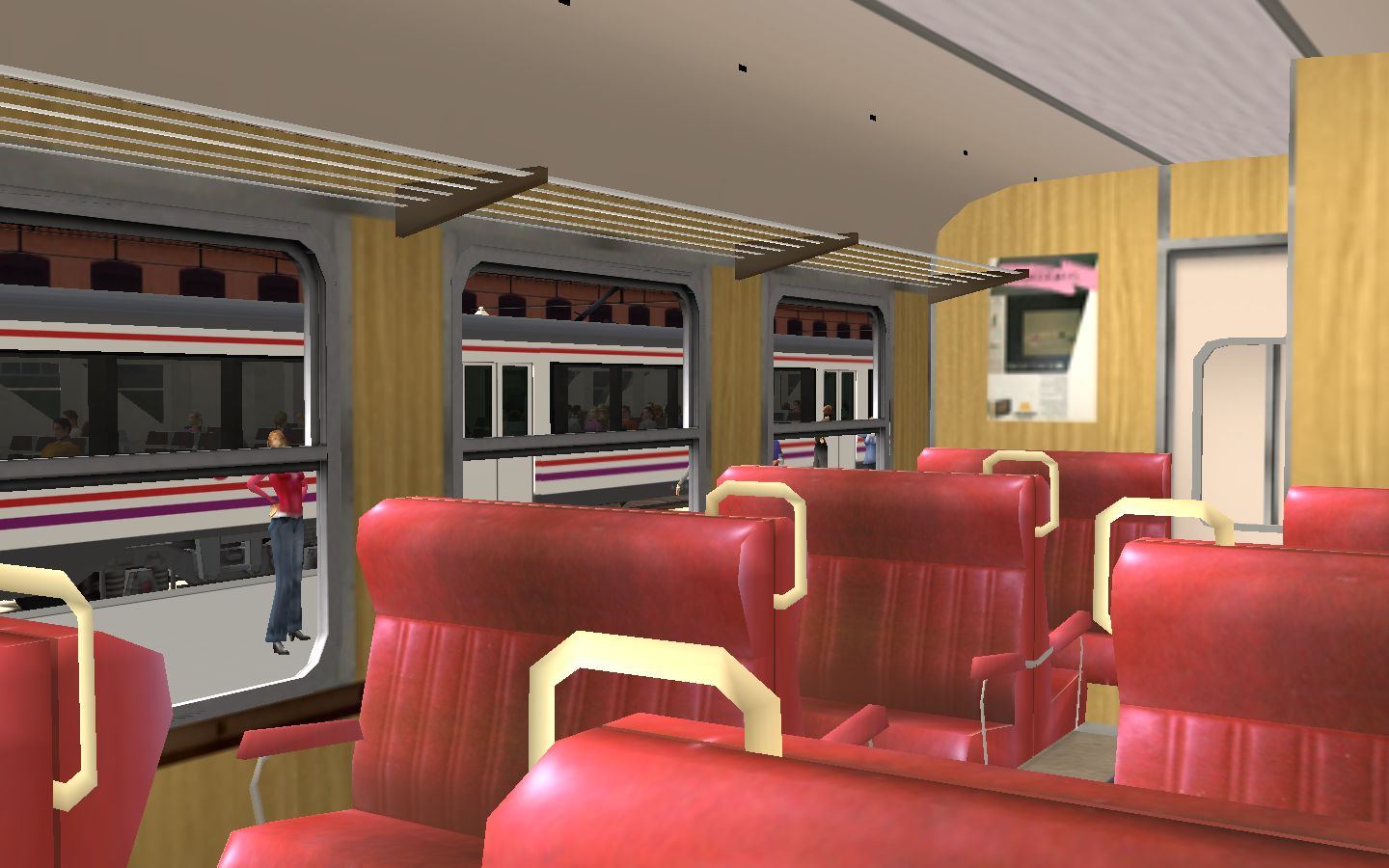
In the first units, the red imitation leather seats of the cars were fixed (they cannot be adjusted to the direction of motion) by opposing pairs :


On the web, you have a lot of pictures of these original 440 units of blue and yellow color, like 440-001-6, 440-080 (1988), 9-440-096-6 (preserved), 440-140 (1991), 440-206 (1988), 440-250 (1991).


The best picture gives the front of the 8-440-133-7 !

 
Nearby Services (Cercanías) :


Between the late 80's and early 90's suburban services needed more and more units to provide services, so that units assigned to regional services were allocated to these services and regional services received old electrotrenes from serie 432.
A great number of these “Unidades Electricas 440” were transferred to Cercanías, the first of them receiving the new colors being in 1990 the 440-080-0 : red, white and black from top to bottom on front cab, with diagonal red, white and black bands on white side cars and a large black bottom strip :


They keep these colors a long time, as some of them had them in 2000 or later.

The 440-113-9 in 1991, the 440-097-4 in 1996 and the 440-084 in 2000 have the same colors on the web.
On STR, for Trainz, you find the 440-029M with 440-073I and 440-063C in the same pack : it is a matter of fact that you never have the same numbers, as all units were exchanged. It is the right composition. This unit is in blue color in 1981 and like above in 1997 on the web.


Details of the cab and the front door before the modernization of these units.


After this period, since 2002 (?), the front cab will be of red and black colors, without the white color, and the red and black side bands will be separated by a white band, the black strip remaining on bottom, the roof being of red color as 440-138-6 in 2002 on the web and many others units... We cannot find them in Trainz with the serie 440, but with serie 470, like this 470-169M :


At last, the "Cercanías" of Renfe Operadora have new colors, since 2005 (?) :


Here, you see on Atocha Station (Madrid) the blue 440-069 at right
and the red 440-029M from Cercanías at left, so in the middle track
the UT 440R Cercanías with the colors of Renfe Operadora : red and
white with two strips on the sides : "red and purple".
The number is 1M. This unit is renovated, as it is shown with its number
440R : great windows, no more front door...


We have to see the renovated units (440R and 470) later.

You find it on Trainz DLS :
UT 440 RM Cercanías = kuid : 69338:640:1 from caa
with RI and RR = 641 and 642.


He also gives the only one Regionales unit on Trainz... but it does not works,
I think. 


and soon you will see the others 440 !
I am working on !

AUTOMOTOR ELÉCTRICO SERIE 432 RENFE

AUTOMOTOR ELÉCTRICO SERIE 432 RENFE


La plupart des lignes de la Catalogne, du Levante et de l’ Andalousie, ont été électrifiées avec du 3.000 volts tandis que la côte cantabrique (Asturies, Cantabrie, Pays Basque ...) et les Pyrénées catalanes l’ont été avec du 1500 V.
Renfe a donc décidé d'acquérir de nouveaux équipements électriques qui pourraient se déplacer sous les deux tensions. Le plan décennal de modernisation des années soixante avait distingué des unités électriques bi- tension selon les critères de confort et de polyvalence des trains TER. Le résultat fut que le nouveau train ressemblait de l’extérieur aux TER, même si son apparence a été améliorée grâce à un rouge vif qui lui donnait un aspect beaucoup plus moderne. Les 432 « plata » sont rouges avec un toit gris.

Most lines of Catalonia, Levante and Andalusia, were electrified with 3,000 volts while the Cantabrian coast (Asturias, Cantabria, Basque Country ...) and the Catalan Pyrenees have been with the 1500 V.

Renfe has decided to purchase new electrical equipment that could move under the two voltages. The decennial plan of modernization of the sixties had distinguished dual voltage electrical units according to the criteria of comfort and flexibility TER trains. The result was that the new train resembled to TER from the outside, although its appearance has been enhanced with a bright red giving it a much more modern look. The 432 "plata" are red with a gray roof.


      Renfe 432-004 "plata" à Calatayud

Les 432 « rojo » sont uniformément rouges. La version classique dispose de bogies Fiat et l’autre de bogies CAF. Sa plus grande puissance (1160kW) et sa vitesse (140 km/h), en a fait l'outil idéal pour répondre aux services de trains de jour pour longues et moyennes distances.


The "rojo" 432  are uniformly red. The classic version has Fiat bogies and other bogies of CAF. Its greatest power (1160kW) and speed (140 kmph), made it the ideal tool to meet the train service daytime for long and medium distances.


       Renfe 432-003-2 "rojo" à Calatayud

Un total de 20 unités ont été fabriquées entre 1971 et 1973 par les sociétés CAF, Macosa et Westinghouse, qui étaient chargées de faire les caisses et la partie mécanique, tandis que Mitsubishi fournissait la partie électrique.

Les nouveaux trains, affectés du numéro 432, mais connus dans le commerce comme "Electrotrenes", firent leurs premiers essais commerciaux en 1971, entre Madrid et Gijón, puis sur les grandes lignes basques, catalanes et andalouses.

Compte tenu des bons résultats obtenus entre 1975 et 1978, une voiture remorque intermédiaire a été ajoutée pour satisfaire le nombre croissant de voyageurs.


A total of 20 units were manufactured between 1971 and 1973 by companies CAF, Macosa and Westinghouse, who were responsible for making the cars and the mechanical part, while Mitsubishi supplied the electrical part.

The new trains, with the number 432, but known by travelers as "Electrotren" made their first commercial trials in 1971 between Madrid and Gijon, then on the long distances of Basque country, Catalonia and Andalusia lines.
Given the good results obtained between 1975 and 1978, an intermediate car trailer was added to satisfy the growing number of travelers.


Remorque centrale de la 432 "rojo" à Calatayud


Intérieur de la 432


Un Electrotren 432 "plata" à Calatayud

Dans le début des années 80, avec l'arrivée de la série 444, les 432 ont été reléguées des services longues distances à des services régionaux à Barcelone, à Madrid, en Andalousie et dans le León. Les 432 ont continué à démontrer leur efficacité et ont été améliorées pour augmenter confort et performance. Au début de 1990, elles ont perdu leur rouge traditionnel pour le bleu et blanc de l'époque et des années plus tard la couleur orange des trains régionaux. L’intérieur a également subi des changements, le compartiment à bagages et le bar étant remplacés par des machines distributrices et un espace de rassemblement. Aujourd'hui, après le faible niveau de certaines unités et la perte de la voiture intermédiaire dans la plupart des unités, certaines restent actives sous les couleurs de la UN Regionales.

Sur TRAINZ, il faut télécharger 3 voitures :

- Motor
- Remolque
- Cabina

Voir "Locomotoras, locomotives" pour les sites de téléchargement avec les liens.

In the early '80s with the arrival of the series 444, the 432 were relegated from long distance services to regional services in Barcelona, Madrid, Andalusia and the Leon. The 432 continued to demonstrate their effectiveness and have been improved to increase comfort and performance. In early 1990, they lost their traditional red for blue and white of the time and years later the orange color of the regional trains. The interior has also undergone changes, the luggage compartment and the bar being replaced by vending machines and a gathering space. Today, after the low level of some units and the loss of the midsize car in most units, some remain active in the colors of UN Regionales..


In Trainz, you need to download 3 cars:

- Motor


- Remolque


- Cabina

Go to "Locomotoras, Locomotives" to find the download stations.

TGV - HIGH SPEED TRAIN - AVE

The Spanish high speed train (AVE)

Since December 2010, Spain is the first European country for
high speed tracks with 2 665 km !

It is a matter of fact that the Spanish Government has quickly embraced the AVE as its main mode of inter-city transportation. They plan on spending over 80 billion Euros in developing a high-speed rail system that will be able to take you across Spain and leave you at no more than 30 miles from your destination (at which point, you can simply take a regular train to your final destination).

On December, 19th, the AVE has linked Madrid to Valencia.
The cost of the substructures amounts to 6,6 billions (euro) with 387 km. The Pato (S - 112 from Talgo) has a velocity of 300 km/h, so Valencia is now at 95 minutes from Madrid, by Cuenca and Requena-Utiel (387 km) with 30 trains a day. The max speed allowed is 330 km/h (10 700 HP).As for the ticket, it will cost 32 euro(s) on the Web and 80 euro(s) at the stations. 

The S - 112 Talgo AVE has from 12 to 23 cars (carriages). With 12 cars, it is 200 m long (322 tons) and load 365 passengers (so, 357 tons). In fact, there are 294 passengers in "turista" class (6 cars and cafeteria car) and 71 seats in "club" class (5 cars).  

The all line to the South East of Spain (Linea de Levante : 955 km) amounted to 12,4 billions (79 bridges and 50 tunnels) and links 19 % of the inhabitants of Spain and 30 % of the RNB. The project has to create 242 000 jobs in 6 years.

Currently, there are several series of High speed trains that run the AVE service:


- S/100, manufactured by Alstom
- S/102, manufactured by Talgo and Bombardier
- S/103, manufactured by Siemens, marketed globally under the brand Siemens Velaro
- S/112, manufactured by Talgo and Bombardier


There are also other series of trains that are considered high-speed, but do not run under the AVE name. They run under the brand Alvia and Avant, and are variable gauge trains. They can run on high-speed lines at a maximum of 250 km/h (155 mph), and can also change between standard- and Iberian-gauge lines without stopping. The trains that are operated under the Alvia brand are:


- S/120, manufactured by CAF and Alstom
- S/130, manufactured by Talgo and Bombardier

In Trainz, you can find 3 Spanish High Speed Trains :

AVE S 100

The first has 4 cars : "Ave-1-0" (motor vehicle) with 3 others cars (Ave-1-1 to 1-3), you can see below on a station of my Madrid-Guadalajara track, I mean Coslada :


 mikado007 : kuid:109502:1000021, 22,23 and 26 (Ave-1-0 to 3) on TRS


The second has two cars, "Ave-2-Cabeza" (the motor vehicle) and "Ave-2-vagon-1" (in fact it seems to be the 1st S-100) :


mikado007 : kuid:109502:1000160 (Ave-2-Cabeza) and 1000161 (Ave-2-Vagon-1) on TRS

AVE S 103 This one just below is the AVE S103 train. It can hit speeds of 350 kilometer per hour at its peak. It can fit 400 passengers and will cost anywhere between 30 to 80 dollars, depending on the class on which you are traveling... with audio and video screens and Internet services.

In Trainz this 3rd AVE has 3 cars : "Ave-3-Cabeza", "Ave-3-Medio" and "Ave-3-Restaurante" :


Renfe AVE S:103 : Linea Madrid-Barcelona, Madrid-Sevilla/Málaga.
mikado007 : kuid:109502:1000030 to 34 (Ave-3-Cabeza, -Medio, -Restaurante...) on TRS


La Serie AVE S:103 o Velaro es un tren construido por Siemens y destinado grácias a su gran velocidad punta a los trayectos "directos" o "semidirectos" en la mayoría de las LAV's de larga distancia españolas. Este tren posee el record mundial de velocidad sobre railes en composición comercial, con una marca de 404 km/h alcanzados en la LAV Madrid-Barcelona.

But the "Pato" from Talgo has to be made ! Even if you can find a prototype on IberTrainz... but I have not tried it and it seems to need some reskin. I will try to make one Pato, but I need measures and some help. If you want to do it with me tell me on the right place below.


STATION MULTIPLE SHIP 023WT

A NEW STATION !
MULTIPLE INDUSTRY... AND TWO SHIPS !

You can load and unload all kinds of products on two ships and a station.


                                           kuid2:427808:10918:1 

You can click on the picture to enlarge it !
The station has two ships : the "Castilla" and the "Bremen".
The first is the "Castilla", which is to be loaded or
unloaded with containers (The "Castilla" is matching with Queue 2).
The loading or unloading docks (at right of the ship) are matching with
Queue 1 (only with containers), as I will explain below. You cannot load or unload cars in these parts of the station, if you don't want to have a car above some containers ! If you like it, it is not a problem, but it will be no realistic !

You may have 200 containers over static lots of containers. If the Queue 1 is to be unloaded, it is better to put on the Queue 200 containers, but if this Queue is to be loaded, it is better to begin with 0 ! It is the same with the ship, but with 92 containers.


The first ship is the "Bremen", which can be loaded
and unloaded with all products you find in Trainz. This ship is matching with Queue 3 and the quay where the ship is docked with Queue 5.
As for Queue 4 and Queue 6, between the two tracks and at right of the Bremen, they can be loaded or unloaded with all kinds of products. Queue 4 is the closest and Queue 6 is near the containers of the Castilla.
Just below you have Queue 4 with 80 cars (8 x 10) and 50 cars (5 x 10), so 130 cars or others products, but of the same kind. You apply the same rules as for containers (from 0 to 130). 


As for Queue 6, you can put 140 products of the container kind or smaller products like cars as you can see below :

There are placed in 5 groups of 3 times 4 x 8 and one time 3 x 8 and the last group on the other side of the right track with 2 x 8, so 17 x 8 = 136 + 4 others products, so 140 for the all Queue 6 !
You see Queue 5 at right of the "Bremen" and at left of the track with 70 objects of the car kind.

So you have :

Queue 1 : 200 containers at right of the "Castilla"
Queue 2 :  92 containers on the "Castilla"
Queue 3 : 108 products on the "Bremen"
Queue 4 : 130 cars at right of the "Bremen" between the two tracks
Queue 5 : 70 cars just at right of the "Bremen" on the dock at left
Queue 6 : 140 products closest than the cars of Queue 4

And for the all station, 740 products !

But, remember you can have different products on the same Queue.

Now, how to proceed ?

You have to click on the "?" on surveyor or better :

Go to : STATION STEELWORKS - GARE D'ACIERIE

and see  n° 50 Multiple industry station with explanations :

Click here :
Station steelworks


TAF - TER - TALGO

The TAF, “Tren Automotor FIAT”


Renfe Serie 595 (old Serie 9500)


1952 - 1980


The TAF, “Tren Automotor FIAT”, of Italian origin, were commissioned by the Renfe between 1952 and 1954. The 2nd serie have air conditioning (with a raised roof) and aerodynamic front. They were used for long distance route. The units were built by Fiat, the engines developed 505 Hp (575 HP in the standard with air conditioning) and a maximum speed of 120km / h. They had a silver color, like others Spanish trains of this time, but here you have the the two tones of blue used since 1968 (you can click on all pictures to enlarge them !).


                  Train TAF in Navalmoral station


The first TAF arrived from Italia in Barcelona on April 23, 1952. On June, they began to run between Madrid and Barcelona, having two motor cars at the ends and an intermediate trailer car. It was possible to separate the train into two parts, each one with a motor car to provide commercial services in "Y" ways, such as Madrid to Gijón and Santander, whose cars are uncoupled in Palencia, or Madrid to Valencia and Alicante, for which the maneuver was done in La Encina. The TAF accounted for a huge leap in the comfort of rail travel in Spain, as the latest trains had air conditioning.


From 1968, they began to lose its distinctive silver colors for the two tones of blue of the TER. The last TAF in commercial service in Renfe ran on September 28, 1980, from Sevilla to Huelva. The “Caminhos de Ferro Portugueses” had identical trains, supplied by FIAT, that functioned more or less at the same time and were baptized as "Foguet" (Rockets).


If you want to download the TAF go to :

7.  LOCOMOTIVES - LOCOMOTORAS

and click on Trainsim


Serie 597 (9700 according to the old RENFE numbering)

TER (Tren Español Rápido)

1965 – 1995


Tren TER Serie 597 - Tren TER "Regionales" - Tren TER "Payaso"

Following the success of the TAF, a decade later, RENFE purchased the TAR (Tren Automotor Rápido, first name of the TER) in 1962. Serie 597 (9700 according to the old RENFE numbering), better known as the TER train (Tren Español Rápido or Spanish Fast Train) is a diesel train which began operating in 1965 and ended its life in the mid 1990's.


Two TER waiting in Navalmoral station !

The basic unit consists of a motor car and a trailer with cab, while the train is designed for running two coupled single units (four cars in total), allocating to it an intercom door at either end. You can see the junction here with the doors opened :


The motor car is composed of 2nd class and a van, the engine and transmission are placed under the floor, with the bogie of the rear (next to the trailer) which makes traction.

The trailer car is equipped of Class 1 and cafeteria, with the generator that supplies power and air conditioning under the floor. Here you can see the 2nd class and "el tio Fulano" with his paper.


The original numbering serie goes from 9701 to 9760 and subsequently was adopted the international numbering (n° UIC 1971) 597.001 to 597.060. The last digit is the hundreds of nominal vehicle power (775 hp).


597-001-7 to 597-004-1 (9701 to 9704) from FIAT (1964)

597-005-8 to 597-016-5 (9705 to 9716) from FIAT (1964)

597-017-3 to 597-030-6 (9717 to 9730) from CAF (1965)

597-031-4 to 597-060-3 (9731 to 9760) from CAF (1966)


Here, you can see the 597-029-8 from Trainz (IberTrainz). At right, the 597-28-


At first, the TER replaces the TAF in most noble services, passing it to perform secondary or regional services. Since 1972, the new "electrotrenes" (serie 432) eliminated the TER on electrified line services like Madrid - Gijón. The TER was also on some international services, like Madrid - Lisbon, between 1967 and 1989, but was replaced by a Talgo III.

Here, some passengers in the 597-29-8. May be you can see yourself during a trip on Navalmoral !


Since 1985, the 597 received new disc brakes and in the eighties their windshields were reduced in size. Other changes were made with the yellow stripe painted on the windows in first class, and at the end of their life, some units were painted with orange and white, colors of the Unidad de Negocio de Regionales.


You can see at left the front side of the TER (597-099-0) and at right the back side (597-036-3), where the door is automatically opened when you link two units like you can see above. In Trainz the motor unit is always named "M" and the other "Rc". If you joint M-Rc-Rc-M, you will see two kinds of junction between the cars. The different colors of cars below are due to the fact that the left car is a "weathered" unit. In Trainz, you can load weathered and new units of TER and "regionales"... and the n° 28 and 29. In fact, you download it in IberTrainz. Click on the link above (locomotives) and on IberTrainz.


The last journey made by a TER took place on January 16, 1995, between the towns of Madrid and Cuenca, by the 597-052. Soon after, other units are sold to Argentina, the rest are dismantled in Arrigorriaga, but three that remain today.


TALGO (1964 - 2009)


TALGO (Tren Articulado Ligero Goicoechea Oriol), por su diseñador Alejandro Goicoechea y su mecenas José Luis Oriol Urigüen en 1942.


Del Talgo III RD (Rodadura Desplazable), existe una única rama en servicio entre Barcelona y Montpelier. El Talgo III RD fue el primer tren capaz de circular por vías de diferente ancho sin cambiar de ejes. El primer servicio lo realizó con una locomotora 2000 T, en la relación Madrid-Barcelona , en agosto de 1964. La composición de un Talgo III con una locomotora 2000 T alcanzó los 200 km/h por primera vez en España, en el tramo de Sevilla-Los Rosales en Junio de 1966. Se inauguró la línea directa Madrid-Paris con un Talgo III en 1968 sin trasbordo de pasajeros en la frontera, arrastrado por la locomotora “Virgen de Lourdes”.

Talgo (Light Articulated Train Goicoechea Oriol), by its designer Alejandro Goicoechea and José Luis Oriol Urigüen (1942).


Talgo III RD (RD means with variable gauge) has a single line service between Barcelona in Spain and Montpelier in France.Talgo III was the first train to travel on tracks of different widths without changing bogies. The first service was carried out with a locomotive 2000 T between Madrid and Barcelona, in August 1964. The Talgo III with a 2000 T locomotive reached 200 km / h for the first time in Spain between Sevilla and Los Rosales in June 1966


The direct line Madrid-Paris with a Talgo III was opened in 1968 without transfer of passengers at the border, drawn by the locomotive "Our Lady of Lourdes".


The Talgo RD TEE from Trainz with a locomotive Renfe 276

(on TRS, you have to download the Renfe 276, the "furgon generador" (first and last cars), the "primera" class car, the "segunda" class car and the "bar" car. 

Un tren Talgo se diferencia de los demás con tan sólo mirarlo con atención, la altura de la composición es inferior a la del resto, son coches más cortos y no hay una diferenciación clara de un coche con otro. 222 Km/h por primera vez en España son alcanzados con una composición de Talgo III con la “Virgen de la Bien Aparecida” a la cabeza en 1972 entre Madrid-Barcelona. Composiciones más bajas implica un centro de gravedad más bajo, lo que nos lleva a una mayor estabilidad. El último servicio de Talgo III realizó el 26 de julio de 2009 al desaparecer la ruta que realizaba con el nombre de “Miguel de Unamuno”.

Talgo train differs from others by simply looking at it closely, the height of the composition is less than the rest, cars are shorter and there is no clear differentiation between two cars. 222 km / h for the first time in Spain are made with a composition of Talgo III with the "Virgen de la Bien Aparecida" in 1972 between Madrid and Barcelona. A lower center of gravity leads to greater stability. The last service of Talgo III held on July 26, 2009 with the disappearance of the route carried out under the name of "Miguel de Unamuno".


Above, the last car (furgón regenerador) and the 1st class (Primera).
And below, a white Talgo.